Fast Arithmetic Tips : Addition

1. Addition of 5
When adding 5 to a digit greater than 5, it is easier to first subtract 5 and then add 10.
For example,

8 + 5 = 13.
Also 8 - 5 = 3; 3 + 10 = 13.

12 + 5 = 17.
Also 12 - 5 = 7; 7 + 10 = 17.


2. Subtraction of 5
When subtracting 5 from a number ending with a a digit smaller than 5, it is easier to first add 5 and then subtract 10.
For example,

26 - 5 = 21.
Also 26 + 5 = 31; 31 - 10 = 18.

23 - 5 = 18.
Also 23 + 5 = 28; 28 - 10 = 18.

23 - 5 = 18.
Also 23 + 5 = 28; 28 - 10 = 18.

Division by 5
Similarly, it's often more convenient instead to multiply first by 2 and then divide by 10.
For example,

1375/5 = 2750/10 = 275.

980/5 = 1960/10 = 196.

Multiplication by 5
It's often more convenient instead of multiplying by 5 to multiply first by 10 and then divide by 2.
For example,

140×5 = 1400/2 = 700.

135×5 = 1350/2 = 675

120×5 = 1200/2 = 600

it's more quick right ?!

Division/multiplication by 25
Use operations with 4 instead.
For example,

37×25 = 3700/4 = 1850/2 = 925.


Add a sequence from one to a selected
1-digit number and back

Choose a 1-digit number.
Square it.

Example:

If the 1-digit number selected is 7:
To add 1 + 2 + 3 + 4 + 5 + 6 + 7 + 6 + 5 + 4 + 3 + 2 + 1
Square 7: 49
So the sum of all numbers from 1 through 7 and back is 49.

See the pattern?

If the 1-digit number selected is 9:
To add 1 + 2 + 3 + 4 + 5 + 6 + 7 + 8 + 9 + 8 + 7 + 6 + 5 + 4 + 3 + 2 + 1
Square 9: 81
So the sum of all numbers from 1 through 9 and back is 81.

Basic statistics formulas

Statistics is a mathematical science pertaining to the collection, analysis, interpretation, and presentation of data. It is applicable to a wide variety of academic disciplines, from the physical and social sciences to the humanities; it is also used and misused for making informed decisions in all areas of business and government. (wikipedia.org)
its include histogram graphics theory, probability, ANOVA, Summarizing data, deviation, Correlation and causation, etc.

Download Basic Statistics Formula List
it include : Measures of Location, Sets, Probability, Measures of spread, deviation, Normal density function, Confidence intervals for the mean, Hypothesis test for the mean , and Simple linear regression


Basic Practice of Statistics

it include : Exploring Data: Distributions, Producing Data, Probability and Sampling
Distributions, Basics of Inference, Inference About Means, The Chi-Square Test, One-way Analysis of Variance: Comparing Several Mean, Inference for Regression.

Introduction to Statistics formula sheets
this document include : Descriptive statistics, Scienti c notation on the calculator, Statistical inference, Normal curve

Trygonometric Delights, and introduction of trygonometry free books

in this post I provide a simple review of the two free books that I found after browsing about trigonometry, there is no end to the discussion of the triangle, we can explore a part of this mathematics ranging from history, until a new theory about the true triangle, two books that can be download for free following a discussion about two different things but actually interrelated, the first book can be downloaded at the following link

This Book Begins by examining the "proto-trigonometry" of the Egyptian pyramid builders. It shows how Greek astronomers developed the first true trigonometry. It traces the Slow Emergence of modern, analytical trigonometry, recounting its Origins in Renaissance Europe's quest for more accurate Artillery, more precise clocks, and more pleasing musical instruments.
The following book reveals history from time to time regarding the development of a triangle formula as well as its application in building the history of human civilization, for example about, Recreational Mathematics in Ancient Egypt, Epicycloids and Hypocycloids, more information, please read and downloaded directly on the link provided.
Download Link


An introduction to TRIGONOMETRY
The next is a book that should be compulsory reading for lovers or for beginners to learn trygonometry, why because this book presents the complete formula, an explanation of the basics trygonometry very important to understand.for exampleTrigonometric circle and AnglesTrigonometric numbers of a real number tBasic formulasRelated valuesTrigonometric functionsInverse trigonometric FunctionsSum formulasTrigonometric equationsfor more details please read and learn more at the link below
Read Online

Best mathematics Integral help website

Integration is an important concept in mathematics and, together with differentiation, is one of the two main operations in calculus. Given a function ƒ of a real variable x and an interval [a, b] of the real line, the definite integral.
to learn more about integral, here i write some list that i think best online help of integral.

1. Wolfram Integral
http://integrals.wolfram.com/index.jsp
The Wolfram Mathematica Online Integrator is powered by webMathematica, so it expects input to be in Mathematica syntax, it very easy to solve integral problem, just write your mathematics integral then click Compute, the results will display in a second.
before write your mathematics expression, learn the expression and syntax first

2.Edu Media
http://www.edumedia-sciences.com/en/a357-integral
this website provide trial graph of integration, A graphic illustration of the integral of a function. You can change the limits of integration and the number of rectangles employed for the approximation. by Click and drag the limits of integration then select a function and the number of rectangles to be used for the approximation.

3. SOS MATH
http://www.sosmath.com/tables/tables.html one my favorite website in mathematics, SOS math provide various type of integral function and formula.The tables will be organized by topics

4. Mathematics Reference
http://www.alcyone.com/max/reference/maths/integrals.html
we can get Essential rules for integration in this website from basic integral, trigonometry integral, Hyperbolic trigonometry, and others

5. Inmath
http://www.intmath.com/
this site give us to explores some of the techniques for finding more complicated integrals, By studying the techniques in this chapter, you will be able to solve a greater variety of applied calculus problems.

6. Lamar.Edu
http://tutorial.math.lamar.edu/
this side also provide integral list in pdf format, so we can download it easily and free,from basic, common formula, until trigonometric formula.

so after learning the function, try to finish some question and math problems below


integral calculus -

best online calculus help website

various online help of calculus available in internet, every those website have their advantage, we can choose which website that can fit with what we need.
below some list calculus website with their unique facilities

1. http://www.calculus-help.com/
this website provide various facilities with unique multimedia tutorial, problem's this week can become interactive tutorial source, available from 1998 until 2003,you can see those example at http://www.calculus-help.com/oldproblems.html
other interactive multimedia tutorial available at calculus phobe, Understanding that enormous tome is just as plausible as whittling a canoe from a giant redwood tree. Welcome to your oasis of understanding. The tutorials that follow explain calculus audio-visually, and are the equivalent of a personal tutoring session. More than just boring lectures, the topics come alive with Flash animation. see more at http://www.calculus-help.com/funstuff/phobe.html


2. http://www.tutorvista.com
i will vote that this website is the best online tutorial for calculus, with their slogan "Get calculus help, a calculus tutor is online to help you"
We use the computer, which your child associates with entertainment and fun, to make learning more interesting.

The student works one-on-one with a professional tutor in a secure web environment using your existing computer, web browser and broadband Internet connection - no special equipment or software is needed.

Using the virtual whiteboard workspace both tutor and student draw and write to share problems, solutions and explanations, and work with simulations and animations to maximize learning. but you need about $99.99/month flat rate to get online help for 24 our.

3.http://www.calculus.org/
this website special for any body that need various link to learn more about calculus, because at this website we can find a lot of link calculus tutor, interactive link for learn calculus, sample exam's, calculus applet's, link for online text, vector calculus, and calculator link for calculus like derivatives and others.

4. http://calc101.com/
this website also have special feature, on this website we can solve the calculus problem online, for example to solve derivative we can go to http://calc101.com/webMathematica/derivatives.jsp , the java-script that installed on that website will generate step by step to solve the problem that we type on that website.

5. http://www.qcalculus.com/topics.htm
this website provide topic by topic tutorial of calculus, begin with functions with e
exponents,fractions,factoring, trigonometry until antiderivatives and integrals
integrals in particle movement, substitution, integrals for area.

Linear Methods of Applied Mathematics free book


Linear Methods of Applied Mathematics

Orthogonal series, boundary-value problems, and integral operators
Evans M. Harrell II and
James V. Herod


©
Copyright 1994,1995,1996, 1997, 2000 by Evans M. Harrell
II and James V. Herod. All rights reserved.

This is a WWW textbook written by Evans M. Harrell II and James V. Herod,
both of Georgia Tech. It is suitable for a first course on partial differential equations,
Fourier series and special functions, and integral equations. Students are expected
to have completed two years of calculus and an introduction to ordinary
differential equations and vector spaces. For recommended 10-week and
15-week syllabuses, read the
preface.


This text concentrates on mathematical concepts rather than on details of calculations,
which are often done with software, such as Maple or Mathematica.
It is not necessary to have experience
with
Maple or Mathematica
in order to read this text, nor is it the goal of this
text to teach software, but there are links in the text to
Maple worksheets and Mathematica notebooks, which perform calculations
and provide some supplementary instructive material. The supplementary
material exists both in a "flat" form, which can be read with Netscape, and
also in an active form, requiring mathematical software.


If you have access to mathematical software, you
may wish to take this opportunity to
set up the latest
version of Netscape to launch Mathematica or Maple automatically when appropriate.


You are welcome to browse, but if you make more than casual use, such as downloading
files or using them as study materials, certain restrictions and fees apply. Before
proceeding, please

Diagnostic quiz
Please take this before embarking on a course from this book.


Links to review materials on

ordinary differential equations
and

linear algebra


Linearity

Also available in an
Adobe Acrobat version

The geometry of functions
Also available in an
Adobe Acrobat version

The red syllabus and the yellow syllabus continue with Chapter III
The green syllabus continues with

Chapter XIII
Fourier series. Introduction.
Also available in an
Adobe Acrobat version (without links)

Calculating Fourier series.
Also available in an
Adobe Acrobat version (without links)
test at this stage.

Differentiating Fourier series.
Also available in an
Adobe Acrobat version (without links)

The red syllabus continues with Chapter VI
The yellow syllabus continues with
Chapter XIII
Notes on a vibrating string.
Also available in an
Adobe Acrobat version (without links)

Traveling waves.
Also available in an
Adobe Acrobat version (without links)
test at this stage.

Mathematics of hot rods.
Also available in an
Adobe Acrobat version

PDEs in space. (includes potential equations)
Also available in an
Adobe Acrobat version (without links)

PDEs on a disk.
Also available in an
Adobe Acrobat version (without links)

test at this stage.
Great balls of PDEs.
Hunting for eigenvalues.

Geometry and integral operators.
Solving Y = KY + f.
test at this stage.

Ordinary differential operators.
Finding Green functions for ODEs.
test at this stage.

Green functions, Fourier series, and eigenfunctions.
Partial differential operators - classification and adjoints.
The free Green function and the method of images
test at this stage.
The fundamental solution of the heat equation
Using conformal mapping to construct Green functions.
Some advanced topics.

Multivariable Calculus

This is a textbook for a course in multivariable calculus. It has been used for the past few years here at Georgia Tech. The notes are available as Adobe Acrobat documents,

this book also available online at http://www.math.gatech.edu/~cain/notes/calculus.html, written by George Cain and James Herod


Title page and Table of Contents


Table of Contents


Chapter One - Euclidean Three Space

1.1 Introduction

1.2 Coordinates in Three-Space

1.3 Some Geometry

1.4 Some More Geometry--Level Sets


Chapter Two - Vectors--Algebra and Geometry

  2.1 Vectors

  2.2 Scalar Product

  2.3 Vector Product


Chapter Three - Vector Functions

  3.1 Relations and Functions

  3.2 Vector Functions

  3.3 Limits and Continuity


Chapter Four - Derivatives

  4.1 Derivatives

  4.2 Geometry of Space Curves--Curvature

  4.3 Geometry of Space Curves--Torsion

  4.4 Motion


Chapter Five - More Dimensions

  5.1 The space Rn

  5.2 Functions


Chapter Six - Linear Functions and Matrices

  6.1 Matrices

  6.2 Matrix Algebra


Chapter Seven - Continuity, Derivatives, and All That


  7.1 Limits and Continuity

  7.2 Derivatives

  7.3 The Chain Rule


Chapter Eight - f:Rn-› R

  8.1 Introduction

  8.2 The Directional Derivative

  8.3 Surface Normals

  8.4 Maxima and Minima

  8.5 Least Squares

  8.6 More Maxima and Minima

  8.7 Even More Maxima and Minima


Chapter Nine - The Taylor Polynomial

  9.1 Introduction

  9.2 The Taylor Polynomial

  9.3 Error

  Supplementary material for Taylor polynomial in several variables.


Chapter Ten - Sequences, Series, and All That


  10.1 Introduction

  10.2 Sequences

  10.3 Series

  10.4 More Series

  10.5 Even More Series

  10.6 A Final Remark


Chapter Eleven - Taylor Series

  11.1 Power Series

  11.2 Limit of a Power Series

  11.3 Taylor Series


Chapter Twelve - Integration

  12.1 Introduction

  12.2 Two Dimensions


Chapter Thirteen - More Integration

  13.1 Some Applications

  13.2 Polar Coordinates

  13.3 Three Dimensions


Chapter Fourteen - One Dimension Again

  14.1 Scalar Line Integrals

  14.2 Vector Line Integrals

  14.3 Path Independence


Chapter Fifteen - Surfaces Revisited

  15.1 Vector Description of Surfaces

  15.2 Integration


Chapter Sixteen - Integrating Vector Functions

  16.1 Introduction

  16.2 Flux


Chapter Seventeen - Gauss and Green

  17.1 Gauss's Theorem

  17.2 Green's Theorem

  17.3 A Pleasing Application


Chapter Eighteen - Stokes

  18.1 Stokes's Theorem

  18.2 Path Independence Revisited


Chapter Ninteen - Some Physics

  19.1 Fluid Mechanics

  19.2 Electrostatics

Calculus from Gilbert Strang


his book is legal to download and available online at http://ocw.mit.edu/ans7870/resources/Strang/strangtext.htm

TOCW is pleased to make this textbook available online. Published in 1991 and still in print from Wellesley-Cambridge Press, the book is a useful resource for educators and self-learners alike. It is well organized, covers single variable and multivariable calculus in depth, and is rich with applications. There is also an online Instructor's Manual and a student Study Guide.

Textbook Components


Table of Contents (PDF)
Answers to Odd-Numbered Problems (PDF)
Equations (PDF)


ChapterS FILES
1: Introduction to Calculus, pp. 1-43


1.1 Velocity and Distance, pp. 1-7

1.2 Calculus Without Limits, pp. 8-15

1.3 The Velocity at an Instant, pp. 16-21

1.4 Circular Motion, pp. 22-28

1.5 A Review of Trigonometry, pp. 29-33

1.6 A Thousand Points of Light, pp. 34-35

1.7 Computing in Calculus, pp. 36-43

Chapter 1 - complete (PDF - 4.1 MB)


Chapter 1 - sections:


1.1 - 1.4 (PDF - 2.8 MB)

1.5 - 1.7 (PDF - 1.6 MB)


2: Derivatives, pp. 44-90


2.1 The Derivative of a Function, pp. 44-49

2.2 Powers and Polynomials, pp. 50-57

2.3 The Slope and the Tangent Line,
pp. 58-63

2.4 Derivative of the Sine and Cosine,
pp. 64-70

2.5 The Product and Quotient and Power Rules, pp. 71-77

2.6 Limits, pp. 78-84

2.7 Continuous Functions, pp. 85-90
Chapter 2 - complete (PDF - 4.3 MB)


Chapter 2 - sections:


2.1 - 2.4 (PDF - 2.6 MB)

2.5 - 2.7 (PDF - 2.0 MB)
3: Applications of the Derivative,
pp. 91-153


3.1 Linear Approximation, pp. 91-95

3.2 Maximum and Minimum Problems,
pp. 96-104

3.3 Second Derivatives: Minimum vs. Maximum, pp. 105-111

3.4 Graphs, pp. 112-120

3.5 Ellipses, Parabolas, and Hyperbolas,
pp. 121-129

3.6 Iterations x[n+1] = F(x[n]), pp. 130-136

3.7 Newton's Method and Chaos,
pp. 137-145

3.8 The Mean Value Theorem and l'Hopital's Rule, pp. 146-153
Chapter 3 - complete (PDF - 5.9 MB)


Chapter 3 - sections:


3.1 - 3.4 (PDF - 3.2 MB)

3.5 - 3.8 (PDF - 3.3 MB)
4: The Chain Rule, pp. 154-176


4.1 Derivatives by the Charin Rule,
pp. 154-159

4.2 Implicit Differentiation and Related Rates, pp. 160-163

4.3 Inverse Functions and Their Derivatives,
pp. 164-170

4.4 Inverses of Trigonometric Functions,
pp. 171-176
Chapter 4 - complete (PDF - 2.0 MB)


Chapter 4 - sections:


4.1 - 4.2 (PDF - 1.0 MB)

4.3 - 4.4 (PDF - 1.2 MB)
5: Integrals, pp. 177-227


5.1 The Idea of an Integral, pp. 177-181

5.2 Antiderivatives, pp. 182-186

5.3 Summation vs. Integration, pp. 187-194

5.4 Indefinite Integrals and Substitutions,
pp. 195-200

5.5 The Definite Integral, pp. 201-205

5.6 Properties of the Integral and the Average Value, pp. 206-212

5.7 The Fundamental Theorem and Its Consequences, pp. 213-219

5.8 Numerical Integration, pp. 220-227
Chapter 5 - complete (PDF - 4.8 MB)


Chapter 5 - sections:


5.1 - 5.4 (PDF - 2.2 MB)

5.5 - 5.8 (PDF - 2.8 MB)
6: Exponentials and Logarithms,
pp. 228-282


6.1 An Overview, pp. 228-235

6.2 The Exponential e^x, pp. 236-241

6.3 Growth and Decay in Science and Economics, pp. 242-251

6.4 Logarithms, pp. 252-258

6.5 Separable Equations Including the Logistic Equation, pp. 259-266

6.6 Powers Instead of Exponentials,
pp. 267-276

6.7 Hyperbolic Functions, pp. 277-282
Chapter 6 - complete (PDF - 4.9 MB)


Chapter 6 - sections:


6.1 - 6.4 (PDF - 3.0 MB)

6.5 - 6.7 (PDF - 2.2 MB)
7: Techniques of Integration,
pp. 283-310


7.1 Integration by Parts, pp. 283-287

7.2 Trigonometric Integrals, pp. 288-293

7.3 Trigonometric Substitutions, pp. 294-299

7.4 Partial Fractions, pp. 300-304

7.5 Improper Integrals, pp. 305-310
Chapter 7 - complete (PDF - 2.6 MB)


Chapter 7 - sections:


7.1 - 7.3 (PDF - 1.7 MB)

7.4 - 7.5 (PDF - 1.0 MB)
8: Applications of the Integral, pp. 311-347


8.1 Areas and Volumes by Slices, pp. 311-319

8.2 Length of a Plane Curve, pp. 320-324

8.3 Area of a Surface of Revolution, pp. 325-327

8.4 Probability and Calculus, pp. 328-335

8.5 Masses and Moments, pp. 336-341

8.6 Force, Work, and Energy, pp. 342-347
Chapter 8 - complete (PDF - 3.4 MB)


Chapter 8 - sections:


8.1 - 8.3 (PDF - 1.7 MB)

8.4 - 8.6 (PDF - 2.0 MB)
9: Polar Coordinates and Complex Numbers, pp. 348-367


9.1 Polar Coordinates, pp. 348-350

9.2 Polar Equations and Graphs, pp. 351-355

9.3 Slope, Length, and Area for Polar Curves, pp. 356-359

9.4 Complex Numbers, pp. 360-367
Chapter 9 - complete (PDF - 1.7 MB)


Chapter 9 - sections:


9.1 - 9.2 (PDF)

9.3 - 9.4 (PDF - 1.0 MB)
10: Infinite Series, pp. 368-391


10.1 The Geometric Series, pp. 368-373

10.2 Convergence Tests: Positive Series, pp. 374-380

10.3 Convergence Tests: All Series, pp. 325-327

10.4 The Taylor Series for e^x, sin x, and cos x, pp. 385-390

10.5 Power Series, pp. 391-397
Chapter 10 - complete (PDF - 2.9 MB)


Chapter 10 - sections:


10.1 - 10.3 (PDF - 1.9 MB)

10.4 - 10.5 (PDF - 1.2 MB)
11: Vectors and Matrices, pp. 398-445


11.1 Vectors and Dot Products, pp. 398-406

11.2 Planes and Projections, pp. 407-415

11.3 Cross Products and Determinants, pp. 416-424

11.4 Matrices and Linear Equations, pp. 425-434

11.5 Linear Algebra in Three Dimensions, pp. 435-445
Chapter 11 - complete (PDF - 4.0 MB)


Chapter 11 - sections:


11.1 - 11.3 (PDF - 2.5 MB)

11.4 - 11.5 (PDF - 1.7 MB)
12: Motion along a Curve, pp. 446-471


12.1 The Position Vector, pp. 446-452

12.2 Plane Motion: Projectiles and Cycloids, pp. 453-458

12.3 Tangent Vector and Normal Vector, pp. 459-463

12.4 Polar Coordinates and Planetary Motion, pp. 464-471
Chapter 12 - complete (PDF - 2.2 MB)


Chapter 12 - sections:


12.1 - 12.2 (PDF - 1.2 MB)

12.3 - 12.4 (PDF - 1.1 MB)
13: Partial Derivatives, pp. 472-520


13.1 Surface and Level Curves, pp. 472-474

13.2 Partial Derivatives, pp. 475-479

13.3 Tangent Planes and Linear Approximations, pp. 480-489

13.4 Directional Derivatives and Gradients, pp. 490-496

13.5 The Chain Rule, pp. 497-503

13.6 Maxima, Minima, and Saddle Points, pp. 504-513

13.7 Constraints and Lagrange Multipliers, pp. 514-520
Chapter 13 - complete (PDF - 4.9 MB)


Chapter 13 - sections:


13.1 - 13.4 (PDF - 2.7 MB)

13.5 - 13.7 (PDF - 2.5 MB)
14: Multiple Integrals, pp. 521-548


14.1 Double Integrals, pp. 521-526

14.2 Changing to Better Coordinates, pp. 527-535

14.3 Triple Integrals, pp. 536-540

14.4 Cylindrical and Spherical Coordinates, pp. 541-548
Chapter 14 - complete (PDF - 2.5 MB)


Chapter 14 - sections:


14.1 - 14.2 (PDF - 1.4 MB)

14.3 - 14.4 (PDF - 1.3 MB)
15: Vector Calculus, pp. 549-598


15.1 Vector Fields, pp. 549-554

15.2 Line Integrals, pp. 555-562

15.3 Green's Theorem, pp. 563-572

15.4 Surface Integrals, pp. 573-581

15.5 The Divergence Theorem, pp. 582-588

15.6 Stokes' Theorem and the Curl of F, pp. 589-598
Chapter 15 - complete (PDF - 4.3 MB)


Chapter 15 - sections:


15.1 - 15.3 (PDF - 2.1 MB)

15.4 - 15.6 (PDF - 2.3 MB)
16: Mathematics after Calculus, pp. 599-615


16.1 Linear Algebra, pp. 599-602

16.2 Differential Equations, pp. 603-610

16.3 Discrete Mathematics, pp. 611-615
Chapter 16 - complete (PDF - 1.8 MB)


Chapter 16 - sections:


16.1 - 16.2 (PDF - 1.5 MB)

16.3 (PDF)

Applied Mathematics: Statistical Formulae and Tables

Statistical Formulae 1
Table 1 Binomial Cumulative Distribution Function
Table 2 Poisson Cumulative Distribution Function
Table 3 Standard Normal Cumulative Distribution Function
Table 4 Percentage Points of the Standard Normal Distribution
Table 5 The Student t Distribution
Table 6 The Chi-squared Distribution
Table 7 Mann-Whitney

this file written by www.sqa.org.uk, complete list of statistical table and formula can downloaded in link below
http://www.sqa.org.uk/files_ccc/2004_Applied_Maths_Stats_and_Tables.pdf


Complete Statistics Formula, Table and List


Graph Theory Hand Book


Written by Reinhard Diestel received a PhD from the University of Cambridge, following research 1983-86 as a scholar of Trinity College under Béla Bollobás. He was a fellow of St. John's College, Cambridge, from 1986 to 1990. Research appointments and scholarships have taken him to Bielefeld (Germany), Oxford and the US. He became a professor in Chemnitz in 1994 and has held a chair at Hamburg since 1999.


Graph theory is gaining fast growing importance in college and university education. Its applications in computer science, economics, optimization make graph theory an obligatory part in syllabuses of electrical engineering, operations research, economics majors. Following this trend the number of graph theory textbooks on the market is also fast growing. Reinhard Diestel's work is certainly much more than just a small supplement to the previous works. It is an outstanding attempt to give a firm basis for graph theoretical studies and to give a glimpse of the most current techniques. In order to do that the author covers topics that are not traditional in earlier textbooks or not even covered in any of them.

The book consists of twelve chapters: The basics, Matching, Connectivity, Planar graphs, Colouring, Flows, Substructures in sparse graphs, Ramsey theory for graphs, Hamiltonian cycles, Random graphs, Minors, trees, and WQO.

Download electronic edition version
(PDF Version Download)

this book is legal to download, but if you prefer print edition you can buy at http://www.math.uni-hamburg.de/home/diestel/books/graph.theory/orders.html

Complete Mathematics Formulary

This document contains 66 pages with mathematical equations intended for physicists and engineers. It is intended to be a short reference for anyone who often needs to look up mathematical equations, This document can also be obtained from the author, JohanWevers, This document is Copyright by J.C.A. Wevers. All rights reserved. Permission to use, copy and distribute this unmodified document by any means and for any purpose except profit purposes is hereby granted. Reproducing this
document by any means, included, but not limited to, printing, copying existing prints, publishing by electronic or other means, implies full agreement to the above non-profit-use clause, unless upon explicit prior written permission
of the author.So This Complete Mathematics Formulary is free and legal to download.

Download Complete Mathematics Formula

Here some table of content
Basics 1
1.1 Goniometric functions
1.2 Hyperbolic functions
1.3 Calculus
1.4 Limits
1.5 Complex numbers and quaternions
1.5.1 Complex numbers
1.5.2 Quaternions
1.6 Geometry
1.6.1 Triangles
1.6.2 Curves
Differential equations 20
4.1 Linear differential equations
4.1.1 First order linear DE
4.1.2 Second order linear DE
4.1.3 The Wronskian
4.1.4 Power series substitution
and various others

Universal Algebra Mathematics Book

Universal algebra (sometimes called general algebra) is the field of mathematics that studies the ideas common to all algebraic structures.
In addition to its unifying approach, Universal algebra also gives deep theorems and important examples and counterexamples. It provides a useful framework for those who intend to start the study of new classes of algebras. It can enable the use of methods invented for some particular classes of algebras to other classes of algebras, by recasting the method in terms of universal algebra (if possible), and then interpreting these as applied to other classes. It has also provided conceptual clarification; as J.D. H. Smith puts it, "What looks messy and complicated in a particular framework may turn out to be simple and obvious in the proper general one." (wikipedia.org)

To promote the study of Universal Algebra in the new millennium, the text of the out-of-print original Springer-Verlag Graduate Texts in Mathematics edition, 1981, of A Course in Universal Algebra has been corrected and put in forms suitable for the WWW. Thanks to the support of NSERC it is now available in 8.5 by 11 in. format, using 12 pt. type, in Postscript (PS) format and in Adobe Acrobat PDF format. The postscript file is also available in three different compressions: gzip (.gz), compress (.Z), and zip (.zip).

Download all type of this book at
http://www.math.uwaterloo.ca/~snburris/htdocs/ualg.html


you can also download other algebra book at http://www.maths.tcd.ie/~dwilkins/Courses/111/

Trigonometric Relations and Trigonometric formula for calculus

Trigonometric Relations is relation between each angle of trigonometric function like cos with sin, sin with tang, sinxsin + cosxcos and othes relation
to learn more about trigonometric function from the introduction online, i recommended this site
http://www.ping.be/
this site have enough resources about trigonometric function like :

    Definitions and basics

  • Trigonometric circle and angles
  • Trigonometric numbers of a real number t
  • Basic formulas

    Trigonometric functions

  • The sine function
  • The cosine function
  • The tangent function
  • The cotangent function

    Sum formulas like

  • cos(u - v)
  • cos(u + v)
  • sin(u - v)
  • sin(u + v)
  • tan(u + v)
  • tan(u - v)

pdf version of trigonometric relation you can download at link below, altough is not complete list like online version from ping.be
http://www.koeri.boun.edu.tr

and trygonometric function for calculus identities you can download at link below
http://www.nd.edu/~jharper1/TrigIdentities.pdf


the complete explanation and tutorial about trigonometric identities you can download tutorial that written by Thomas E. Price, from Department of Theoretical and Applied Mathematics, THE UNIVERSITY OF AKRON.
TRIGONOMETRIC IDENTITIES


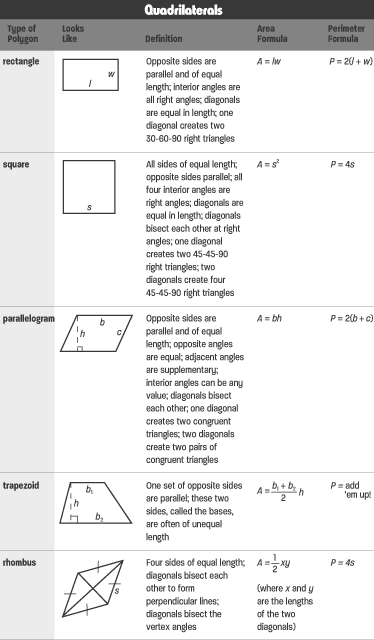
Geometry Reference Formula

Geometry (Greek γεωμετρία; geo = earth, metria = measure) is a part of mathematics concerned with questions of size, shape, and relative position of figures and with properties of space, this science can be found from Egypt, Mesopotamia.

you can looking more about geometry here, picture below shown the basic formula and calculation of basic shape.
1. Polygon Shape


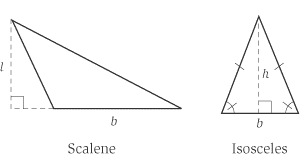
2. Triangle
Here are three different types of triangles:

the triangle type is :
a. Scalene triangles have no equal sides and therefore no equal angles.
b. Isosceles triangles have two equal sides, which means they also have two equal angles
c. Equilateral triangles are a model of uniformity, the interior angles are always 60˚.

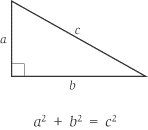
Triangles and Pythagoras

A Pythagoras triangle is a triangle with one 90˚ interior angle (called a right angle). Because the angles of a triangle must total 180˚


for learn more about Geometry and trigonometry you should download PDF file tutorial here

2D Geometry Formula Download
you should download 2D list of geometry formula here, this geometry formula list include, triangle, circular ring, elips, circular ring and others.

You also can download Plane Geometry Formulas by clicking this link

for 2D and 3D geometry formula list you can download from http://www.austincc.edu/by clicking this link

for volume geometry formula list you can download from this link


Integral table List and Formula

Integral table make we more easy to understand and remember integral formula, integral is one of two basic of calculus operation, integral have various type they are :

integrals of rational functions
integrals of irrational functions
integrals of trigonometric functions
integrals of inverse trigonometric functions
integrals of hyperbolic functions
integrals of arc hyperbolic functions
integrals of exponential functions
integrals of logarithmic functions

all type of integral you can download at http://integral-table.com/

or you can download other integral table in pdf here

to learn more how to proof integral table, you can go to http://math2.org

other site that provide integral table is http://infinity.cos.edu/

or you can learn more at free encyclopedia wikipedia and learn about development of calculus in integration at http://kr.cs.ait.ac.th


Basic Statistical Formula

this is Some Basic Statistical Formula article, written ricardo from ecn.edu, this article will explain very basic statistic formula about mean, median, variation, variance, standard deviation and standard error of the mean is an estimation


Basic Statistical formula Download


Statistics formula sheet
second article is about H test, hypothesis test, mean, median, Discrete distributions, Test for population mean, Paired sample t-test, Regression and correlation, and Test for a proportion, at this article is more complete than upper before


Download Basic Statistics formula sheet


file type is pdf


Complete Statistics Formula, Table and List


Basic Statistical Formula - mean, variant, deviation

this is Some Basic Statistical Formula article, written ricardo from ecn.edu, this article will explain very basic statistic formula about mean, median, variation, variance, standard deviation and standard error of the mean is an estimation


Basic Statistical formula Download


file type is pdf


Complete Statistics Formula, Table and List


Distribution, Probability, Sampling, The Chi-Square Test - Basic Practice of Statistics

this post you will able to download Basic Practice of Statistics in pdf format, it's include Exploring Data and Distribution,Producing Data, Probability and Sampling
Distributions,Data Relationships, Basics of Inference, mean, median

and at the last page learn more about The Chi-Square Test, and One-way Analysis of Variance Comparing Several Means, this tutorial include table and formula of Chi-Square test, Standard Normal probabilities table, and Chi-square distribution critical values

Link to Download statistical formula

file format is pdf


Complete Statistics Formula, Table and List


Statistic Formula list

at this post you will able to download mathematic formula with statistic specially in mean,and standard deviation, click link below to download

Statistic Formula - Mean and Deviation .Doc

Statistic Formula - Mean and Deviation .Pdf


and here for probability formula

probability formula

you can choose from those available format, .doc or .pdf


Complete Statistics Formula, Table and List


Calculus Bible Book

this calculus book is an elementary calculus textbook written by Professor G. S. Gill of the Brigham Young University Mathematics Department. contains 370 pages, from basic calculus and complete with the formula and table list, beginning with function, limits and continuity, differentiation and the application, integration and application,
it's free license book, so you can download it and read it free.

Download This Book Here

 
Design by Free WordPress Themes | Bloggerized by Lasantha - Premium Blogger Themes